
President: Chanse Kaczmarski
Background & Inspiration 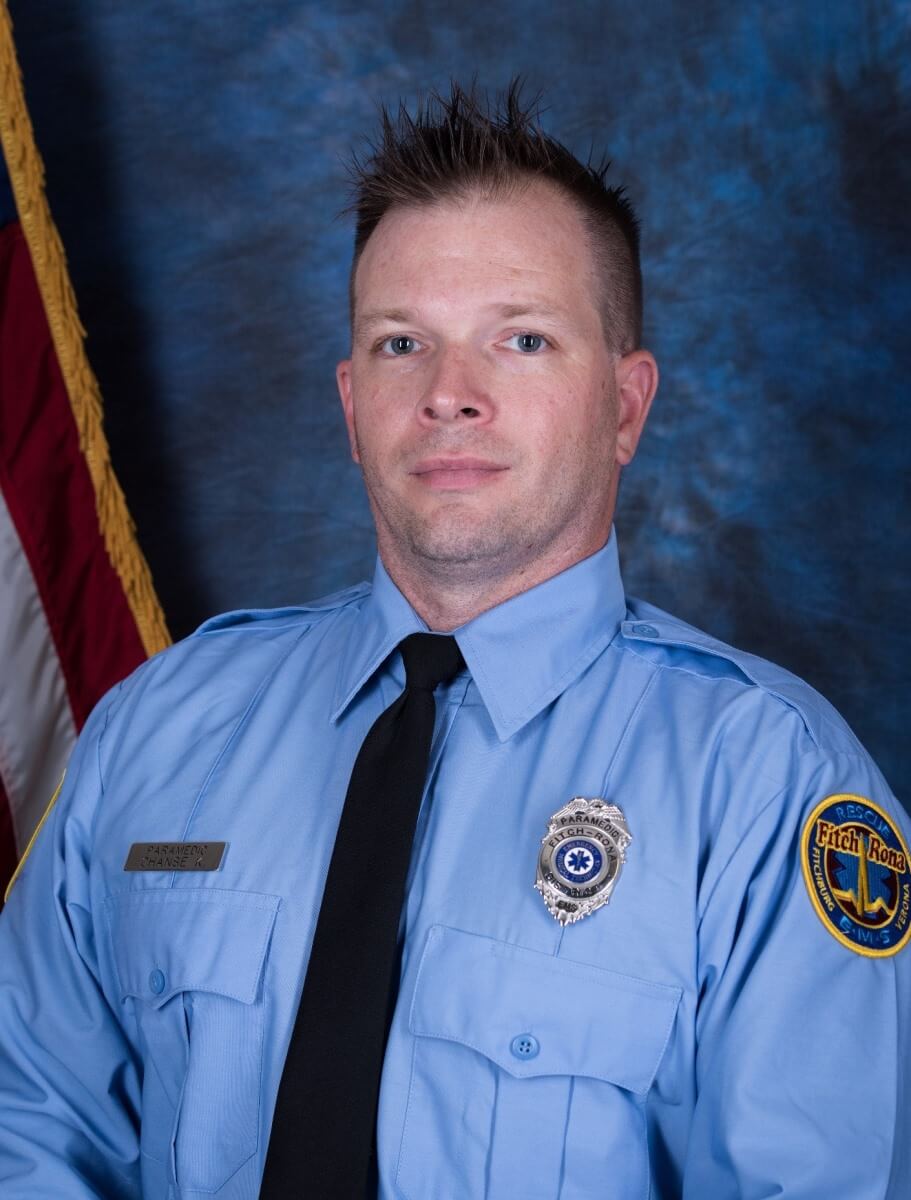
Chanse Kaczmarski has been in EMS since 1995, beginning as a volunteer with Fitch-Rona EMS as an EMT-Basic. His EMT-B course was 31 years ago, and looking back on it now, what strikes him is how much the field has evolved and yet how much value that early training still holds. "It is interesting to look back to that course and still see the value that it had then to now with how far it has evolved to be so much more."
Originally, Chanse had planned to pursue a career in law enforcement. It wasn't until his EMT-B course that he realized he enjoyed the medical side of emergency services more. He went on to pursue both, and today holds certification as a Wisconsin law enforcement officer as well.
Career Path
After his start with Fitch-Rona EMS, Chanse also served with Platteville EMS, Deer-Grove EMS, and New Glarus EMS. He completed his paramedic training at Mercy Regional EMS Training Center in Janesville and became a full-time paramedic with Fitch-Rona EMS in 2002, where he continues to serve today. He is also the Deputy Fire Chief for the Belleville Volunteer Fire Department.
Chanse holds an associate's degree in Police Science and recently completed a bachelor's degree in Fire and Emergency Management at Purdue Global University.
Getting Involved with WEMSA
Chanse's path to the WEMSA board was driven by a very specific moment. When PTSD legislation passed for law enforcement officers and career firefighters but excluded EMS providers, he realized he wanted to do something about it. "I wanted to advocate and provide more of an individual effort to lobby for EMS providers, and WEMSA provided that by giving the opportunity to meet with legislators and advocate for EMS to be included in this bill."
Why Representation Matters
Representing EMS providers in Wisconsin is important to Chanse because, even though there are many fire-based EMS agencies, there are also individual agencies with their own distinct needs. "There are some similarities between advocating for fire and EMS, but for the most part, EMS needs are unique. As EMS evolves, I believe the needs are going to be further distanced from the needs of the fire service and will require further advocacy for ourselves."
The most rewarding part of his time on the board has been seeing EMS providers included in the PTSD legislation. "This took a lot of time and effort, so seeing it finally cross the finish line was very rewarding."
Looking Ahead
Chanse's vision for the future of EMS in Wisconsin is clear: to be recognized as an essential service, viewed as healthcare first and transportation second. "We need to find ways to grow our services and support both rural and urban communities. We also need to continue to look for innovative ways to provide the best and most efficient care to our communities."